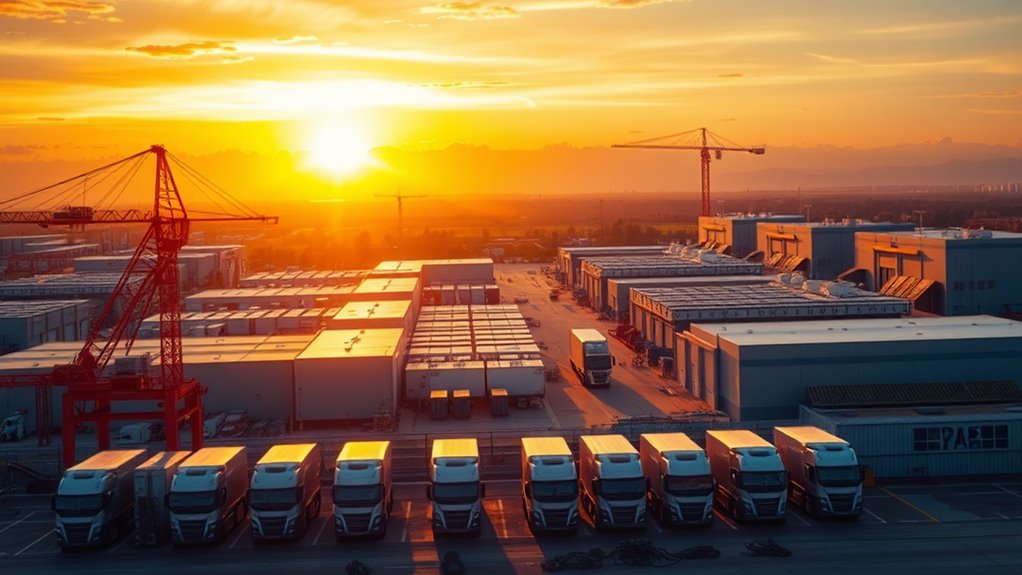
Industrial real estate is emerging as a formidable investment sector driven by the e-commerce boom and increased demand for efficient logistics solutions. The shift toward same-day delivery has heightened the need for strategically located warehouses, reducing vacancy rates considerably. Longer lease agreements provide investors with predictable cash flow, whereas advancements in technology, such as automation and smart logistics systems, improve operational efficiency. Diverse industrial properties offer risk mitigation and strong returns, further boosting their appeal. As the sector adapts to sustainability trends and future growth needs, investors are eager to explore the dynamics shaping this lively market.
The E-Commerce Boom
With the rapid expansion of e-commerce, the demand for industrial real estate has surged dramatically. This paradigm shift in consumer behavior, characterized by an increasing preference for online shopping, has necessitated a reevaluation of logistics strategies among businesses. Companies are compelled to improve their distribution networks to meet the expectations of consumers who demand faster and more reliable delivery options. As a result, the industrial real estate sector has become a focal point for investors seeking stable returns.
Logistics innovation plays a pivotal role in this environment, as businesses invest in advanced technologies and infrastructure to optimize their supply chains. The integration of automation, robotics, and data analytics into warehousing and distribution processes has created a more efficient operational framework. This, in turn, increases the appeal of industrial properties, as these assets are crucial for facilitating seamless logistics operations.
Investors are recognizing that acquiring industrial real estate is not merely a reaction to current trends but a strategic move to utilize ongoing growth in the e-commerce market. The evolution of consumer expectations, coupled with advancements in logistics, underscores the necessity for well-located and technologically equipped industrial spaces. The intersection of online shopping and logistics innovation presents a unique opportunity for savvy investors to position themselves advantageously in a thriving sector. By comprehending these dynamics, investors can exert greater control over their portfolios, ensuring they capitalize on the burgeoning industrial real estate market.
Increased Demand for Warehousing
The rapid growth of e-commerce has considerably heightened the need for efficient warehousing solutions, as businesses endeavor to meet consumer demand for faster delivery. This increased demand underscores the importance of supply chain resilience, prompting companies to invest in more strategic distribution centers. As a result, the industrial real estate sector is experiencing a notable shift in the acquisition and development of modern warehousing facilities.
E-commerce Growth Impact
As e-commerce continues to expand quickly, the demand for warehousing solutions has surged considerably. This growth is primarily driven by shifting consumer behavior, which increasingly favors the immediacy and convenience offered by online shopping. Retailers are compelled to optimize their logistics to improve last mile delivery efficiency, ensuring products reach customers swiftly and reliably.
Key factors influencing this demand include:
- Increased online shopping: Consumers expect rapid fulfillment, prompting businesses to invest in local distribution centers.
- Shift toward same-day delivery: The need for speed necessitates strategically located warehouses to facilitate quick shipping.
- Rise of omnichannel retailing: Companies are blending online and offline sales, requiring more flexible warehousing solutions.
Investors in industrial real estate must recognize that the expansion of e-commerce is not a temporary trend but a structural shift in consumer behavior. By securing properties that meet the growing need for warehousing, they can position themselves advantageously in a competitive market. The interplay between consumer expectations and logistical efficiency places industrial real estate at the forefront of investment opportunities, emphasizing the importance of strategic foresight in this evolving environment.
Supply Chain Resilience
E-commerce growth has underscored the necessity for robust supply chain frameworks, leading to an increased demand for warehousing solutions. As businesses endeavor for supply chain optimization, the need for strategically located warehouses has become paramount. These facilities not only serve as pivotal nodes in the distribution network but additionally improve logistics efficiency, allowing companies to respond swiftly to market fluctuations and consumer expectations.
In today's fast-paced environment, a resilient supply chain is critical. Companies are investing in modern warehousing technologies and designs that facilitate rapid inventory turnover and streamline operations. Advanced inventory management systems and automated fulfillment processes are becoming standard, ensuring that businesses can maintain control over their stock levels whilst minimizing costs.
Furthermore, the focus on sustainability is prompting a shift towards eco-friendly warehousing practices, further improving operational efficiency. As demand for timely deliveries continues to rise, the industrial real estate sector is positioned to capitalize on these trends, appealing to investors who recognize the strategic value of warehousing in maintaining competitive advantage. Fundamentally, the interplay between supply chain resilience and warehousing capabilities is reshaping the terrain of industrial real estate investments.
Longer Lease Agreements
How do longer lease agreements impact the stability and profitability of industrial real estate investments? Longer lease agreements are crucial in solidifying the foundation of industrial real estate portfolios, offering numerous advantages that improve both financial security and operational efficiency.
- Consistent Revenue Streams: Extended lease terms guarantee a predictable cash flow, allowing investors to forecast income accurately.
- Reduced Turnover Costs: Longer leases minimize the frequency of tenant turnover, thereby decreasing the costs associated with lease negotiations and refurbishments.
- Improved Tenant Retention: A stable relationship with tenants cultivates loyalty, leading to higher retention rates and less disruption to business operations.
By securing tenants for extended periods, property owners gain a strategic advantage in an increasingly competitive market. These agreements stabilize income as well as reduce the volatility associated with short-term leasing. Moreover, long lease terms can be a point of leverage during lease negotiations, allowing landlords to negotiate favorable terms that benefit both parties.
Investors can likewise focus on building long-term partnerships with their tenants, leading to improved tenant satisfaction and operational harmony. In the end, longer lease agreements are fundamental to maintaining a resilient industrial real estate investment strategy. They provide a robust framework for financial planning, guaranteeing that property owners can navigate market fluctuations with greater confidence and control. This stability is vital for those looking to maximize investment potential in the dynamic environment of industrial real estate.
Lower Vacancy Rates
Lower vacancy rates in industrial real estate are primarily driven by the increasing demand for space, particularly in the wake of rising e-commerce activities. As businesses expand their logistics and distribution capabilities, the need for warehouse and distribution centers has intensified. This trend not only improves occupancy rates but additionally stabilizes rental income for investors in the sector.
Increased Demand for Space
The surge in industrial real estate demand has led to markedly lower vacancy rates across various markets. This trend underscores a robust shift in investment strategies, driven by several key factors that improve the desirability of industrial spaces. Investors seeking control in their portfolios are increasingly drawn to this asset class owing to its resilience and potential for growth.
- Sustainability practices are becoming integral to modern industrial developments, attracting tenants who prioritize eco-friendly operations.
- Urban development initiatives are broadening available space, catering to the growing need for logistics and distribution centers in metropolitan areas.
- Technological advancements are refining operational efficiency, further solidifying the appeal of industrial properties.
As vacancy rates decline, investors find themselves in a favorable position to capitalize on the growing demand for industrial space. The convergence of sustainability and urban development strategies positions this sector as a viable option for those looking to mitigate risk as they maximize returns. With the environment continuously evolving, comprehending these dynamics becomes imperative for investors aiming to utilize the full potential of industrial real estate.
E-commerce Driving Occupancy Rates
E-commerce has emerged as a significant catalyst for driving occupancy rates in industrial real estate, further contributing to the decrease in vacancy rates observed across various markets. The rapid transformation of consumer behavior, characterized by an increasing demand for immediate delivery, has necessitated the development of advanced last mile logistics strategies. This shift has prompted the establishment of urban fulfillment centers and distribution hubs, strategically positioned to meet consumer expectations.
Moreover, the integration of automation trends and real estate technology has streamlined inventory management processes, enhancing operational efficiency and responsiveness within the supply chain. As companies adopt multi-channel strategies, they are increasingly investing in spaces that facilitate sustainable practices, aligning their logistics with environmental goals.
Supply chain innovation is additionally pivotal, as businesses continuously seek ways to optimize their operations and reduce costs. By prioritizing locations that support these advancements, firms can maintain a competitive edge in the constantly changing e-commerce environment. Consequently, the synergy between e-commerce and industrial real estate not only drives occupancy rates but likewise transforms how companies approach distribution and fulfillment, solidifying the sector's importance in the investment arena.
Technological Advancements
In today's swiftly changing industrial environment, technological advancements play a vital role in shaping investment strategies and operational efficiencies. As investors seek to maximize returns in the industrial real estate sector, it is imperative to understand the impact of these innovations on the environment.
Key benefits of embracing technological advancements include:
- Improved Operational Efficiency: Automation trends streamline processes, reducing labor costs and increasing productivity.
- Enhanced Supply Chain Management: Smart logistics systems optimize inventory management and distribution, facilitating rapid response to market demands.
- Data-Driven Decision Making: Advanced analytics provide insights into performance metrics, enabling informed investment choices.
Investors must recognize that automation trends are merely a passing phase; they represent a fundamental shift toward more efficient operations. By integrating robotics and artificial intelligence into warehouse management, companies can greatly reduce operational delays and human error, leading to more reliable service levels.
Moreover, smart logistics technologies improve the ability to track and manage goods throughout the supply chain, providing real-time visibility. This capability enables businesses to pivot quickly in response to market fluctuations, a vital advantage in today's fast-paced economy.
As industrial real estate continues to evolve, those who leverage the influence of technological advancements will not only improve their operational efficiencies but additionally position themselves advantageously in the competitive investment environment. Embracing these innovations is vital for investors seeking control over their portfolios and ensuring sustainable growth in the industrial sector.
Diversification of Investment Portfolios
Diversifying an investment portfolio in the industrial real estate sector is essential for mitigating risks and enhancing returns. By strategically allocating assets across various industrial properties, investors can cushion their portfolios against market volatility and sector-specific downturns. This approach allows for effective risk management, as the performance of one investment can offset the underperformance of another, encouraging a more stable financial foundation.
Investors should consider a variety of industrial property types, such as warehouses, distribution centers, and manufacturing facilities, to optimize their asset allocation. Each property type presents unique advantages and risks, influenced by market demand, location, and economic conditions. By spreading investments across these categories, investors can leverage the potential of different market segments as they minimize exposure to any single sector's fluctuations.
Moreover, geographic diversification plays a significant role in risk management. Investing in industrial properties across various regions can buffer against localized economic downturns, ensuring that investors remain insulated from unpredictable market shifts. This strategic dispersion of assets not merely stabilizes cash flows but additionally increases the likelihood of capital appreciation over time.
Economic Resilience
Economic resilience within the industrial real estate sector is a crucial factor that influences investment decisions and long-term profitability. Investors are increasingly drawn to this sector because of its ability to withstand economic fluctuations and provide consistent returns. The significance of economic stability cannot be overstated, as it serves as a foundation for effective investment strategies and informed capital allocation.
Key factors contributing to the economic resilience of industrial real estate include:
- Adaptability to market trends: The sector's flexibility allows it to respond swiftly to changes in consumer demand and technological advancements.
- Strong sector performance: Industrial properties often outperform other asset classes during economic downturns, providing a buffer against volatility.
- Strategic urban development: Proximity to transportation hubs and growing urban areas boosts the value and demand for industrial spaces.
Effective risk assessment and asset management practices are vital for maximizing returns in this evolving environment. Investors must stay abreast of market trends, ensuring that their strategies align with current economic conditions. Additionally, the ongoing demand for logistics and distribution centers positions industrial real estate as a pivotal component of urban development initiatives.
Future Growth Projections
As the industrial real estate sector demonstrates remarkable economic resilience, the focus shifts toward its future growth projections. Analysts anticipate continued expansion driven by several critical factors, particularly the increasing need for logistics space and the ongoing evolution of urban development. The rise of e-commerce has fundamentally altered consumer behavior, mandating that businesses adapt by securing strategically located facilities to guarantee timely product delivery. This trend is expected to sustain demand for industrial spaces, particularly in urban areas where land is limited yet necessary for operations.
Moreover, sustainability initiatives are becoming paramount in shaping the future of industrial real estate. Investors and developers are increasingly recognizing the importance of environmentally responsible practices, such as energy-efficient designs and sustainable materials. The integration of these initiatives not just boosts the appeal of properties but additionally aligns with the regulatory frameworks that favor green building standards. As municipalities prioritize eco-friendly developments, properties that embrace sustainability are likely to enjoy higher valuations and increased occupancy rates.
Furthermore, advancements in technology, such as automation and smart logistics, will influence the design and functionality of industrial spaces. Facilities equipped with state-of-the-art technology will attract tenants looking to optimize operations and reduce costs.
Frequently Asked Questions
What Types of Properties Are Included in Industrial Real Estate?
Envision a well-oiled machine, where each component plays a crucial role in seamless operation. This metaphor aptly describes industrial real estate, encompassing various property types such as manufacturing facilities, logistics centers, warehouse spaces, distribution hubs, flex properties, and cold storage units. Each type serves a unique purpose, contributing to a robust supply chain. Comprehending these categories allows investors to strategically position themselves in the dynamic terrain of industrial real estate, nurturing control over their investment portfolios.
How Do Location and Zoning Affect Industrial Real Estate Investments?
Location plays an essential role in industrial real estate investments, as proximity to transportation networks, suppliers, and customers can greatly improve operational efficiency. Furthermore, zoning regulations determine permissible uses for properties, impacting their desirability and potential returns. Investors must carefully evaluate these factors to guarantee compliance and optimize asset performance. Comprehending the importance of location and zoning not just aids in risk mitigation but also improves strategic decision-making in securing profitable investments.
What Are the Risks Associated With Investing in Industrial Real Estate?
Investing in industrial real estate entails several risks that require careful consideration. Market volatility can greatly impact asset values, as tenant default poses a substantial threat to rental income. Moreover, compliance with stringent environmental regulations may impose unexpected costs. Maintenance costs can escalate, especially in older facilities, and economic downturns can lead to decreased demand. In addition, the rapid pace of technological advancements necessitates ongoing investment to keep properties competitive, adding another layer of complexity.
How Can Investors Finance Industrial Real Estate Acquisitions?
Financing industrial real estate acquisitions is akin to assembling a precise puzzle, where each piece contributes to the overall picture of success. Investors can explore various avenues such as equity financing, debt options, and joint ventures. Crowdfunding platforms and institutional investors offer innovative funding solutions, as strategic market analysis informs investment decisions. Furthermore, leveraging tax incentives can improve returns, and effective asset management guarantees the sustainability of investments in this burgeoning sector.
What Trends Are Shaping the Future of Industrial Real Estate?
Emerging trends shaping the future of industrial real estate include significant automation impact, driven by advancements in technology integration. E-commerce growth continues to demand efficient logistics advancements, necessitating strategic supply chain optimization. Furthermore, sustainability initiatives are becoming imperative, as investors increasingly prioritize environmentally responsible practices. Collectively, these trends not only improve operational efficiency but likewise provide investors with greater control over their assets, ensuring long-term viability and competitive advantage in the market.
