
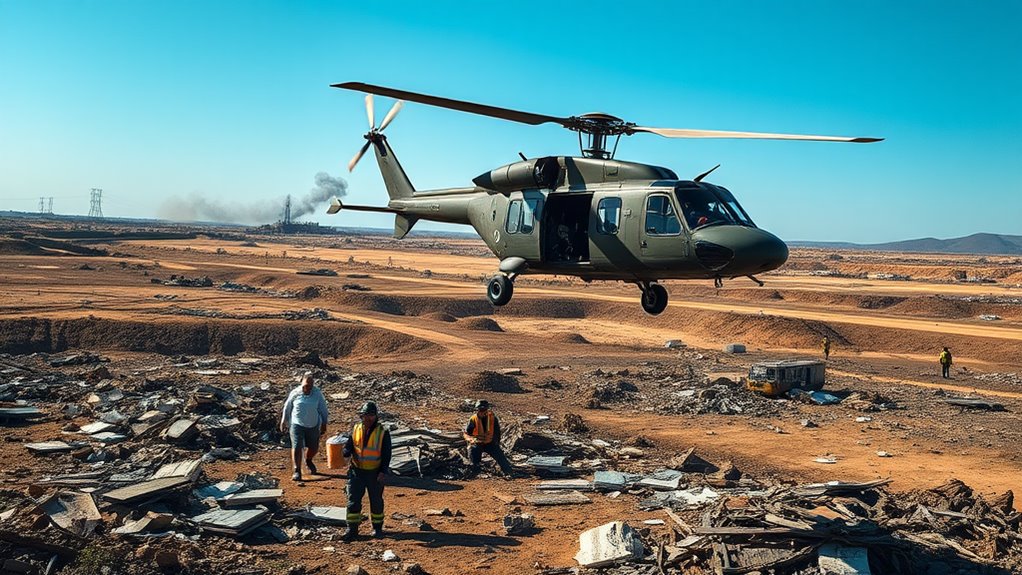
Aviation is crucial in disaster relief because of its ability to provide rapid access to affected regions. It allows for the swift transport of critical supplies such as medical assistance, food, and water, often outperforming ground transportation in urgency. Helicopters and aircraft can reach remote areas, facilitating quick evaluations of damage and resource needs. Furthermore, aviation improves coordination among relief organizations, optimizing resource allocation. Medical evacuations become possible, greatly enhancing survival rates. The integration of advanced technology, including drones, further aids in evaluating situations. Exploring these aspects reveals the extensive impact of aviation in addressing disaster scenarios.
Speed of Response
Responding promptly to disasters is critical in mitigating their impact, and aviation plays a pivotal role in enabling quick access to affected areas. The speed of response in disaster relief operations is fundamentally linked to the effectiveness of emergency logistics, which encompasses the coordination of resources, personnel, and information necessary for timely assessments of the situation on the ground. Aviation assets, including helicopters and fixed-wing aircraft, can deliver humanitarian aid and emergency services far more swiftly than ground transportation, particularly in regions where infrastructure has been compromised.
In the chaotic aftermath of a disaster, the ability to conduct aerial reconnaissance allows for immediate evaluations of damage, aiding decision-makers in prioritizing interventions. This advantage is further amplified by the capacity of aircraft to transport medical supplies, food, and clean water directly to affected populations, thereby addressing urgent needs without delay.
Furthermore, the integration of aviation into emergency logistics improves coordination among various stakeholders, including government agencies, non-governmental organizations, and international aid organizations. The ability to establish temporary airstrips or utilize existing airports enables quick mobilization of resources, thereby facilitating a more organized and effective response. These collaborative efforts are vital in ensuring that aid reaches those in need without unnecessary delays. Additionally, the dedicated personnel working behind the scenes—often referred to as the unsung heroes in airport operations—play a crucial role in managing complex logistics and ensuring that flights are efficiently scheduled and maintained. Their expertise not only streamlines the delivery of essential supplies but also enhances the overall effectiveness of disaster response initiatives.
Access to Remote Areas
Even though many disaster-stricken regions are accessible by road, numerous remote areas remain isolated due to damaged infrastructure or geographic challenges, making aviation an crucial tool for relief efforts. In such scenarios, aviation facilitates not just swift access but also the effective assessment of affected locales, thereby enhancing operational planning.
Helicopter logistics play a significant role in reaching inaccessible locations where conventional ground transportation may be impeded by debris, landslides, or flooding. Helicopters can be deployed to transport personnel, medical teams, and critical equipment directly to remote sites, reducing the time required to initiate life-saving interventions. Their vertical lift capability allows them to navigate rugged terrains and challenging weather conditions, ensuring that aid can reach the most vulnerable populations.
Moreover, aerial reconnaissance is fundamental for evaluating the extent of damage and identifying crucial needs in isolated areas. By utilizing advanced imaging technology, helicopters can survey vast expanses quickly, providing real-time data to relief agencies. This information informs decision-making processes, enabling responders to allocate resources efficiently and prioritize interventions where they are most urgently needed.
Delivery of Critical Supplies
The delivery of critical supplies during disaster relief operations hinges on rapid response capabilities and the ability to access remote areas. Aviation plays a pivotal role in overcoming logistical challenges, ensuring that crucial resources reach affected populations swiftly. This capability not just mitigates the impact of disasters but likewise supports recovery efforts in the most inaccessible regions.
Rapid Response Capabilities
In times of crisis, the ability to swiftly deliver vital supplies can mean the difference between life and death. Rapid response capabilities in aviation play a significant role in ensuring that important resources, including food, medical supplies, and shelter materials, reach affected populations with unprecedented speed. The integration of aviation partnerships improves these capabilities, allowing for a coordinated approach to emergency preparedness that leverages both governmental and non-governmental resources.
Aircraft equipped for rapid logistics can deploy to disaster zones with minimal lead time, overcoming logistical barriers that ground transportation faces in the aftermath of catastrophic events. This agility is vital, especially in scenarios where traditional supply routes are compromised or entirely obstructed. The collaborative efforts among various aviation stakeholders—ranging from commercial airlines to specialized cargo operators—further amplify the effectiveness of relief missions.
Remote Area Access
How can aviation transform the delivery of vital supplies to remote areas during disasters? The integration of aviation, particularly through helicopter logistics, plays a key role in overcoming the terrain challenges that frequently impede ground transportation. Disasters often render traditional routes impassable, isolating affected populations and complicating relief efforts. Helicopters, with their ability to access areas that are otherwise unreachable, provide an agile solution for transporting fundamental supplies such as food, water, and medical equipment directly to those in need.
In addition to speed, helicopters can be equipped to hold a variety of payloads, making them versatile assets for disaster relief operations. They are capable of landing in constrained environments, utilizing advanced aerial delivery systems to drop supplies when landing is impractical. This capability is especially important in rugged terrains, where ground vehicles may be delayed or entirely ineffective.
Ultimately, leveraging aviation for remote area access not just improves the efficiency of disaster response but also mitigates the impact of natural calamities on vulnerable communities. By prioritizing helicopter logistics, relief organizations can guarantee timely, effective delivery of vital supplies, greatly improving outcomes during disaster recovery efforts.
Coordination of Relief Efforts
Effective coordination of relief efforts is vital in guaranteeing timely and efficient responses to disasters. The intricacies inherent in disaster scenarios necessitate robust communication strategies that facilitate seamless interaction among various stakeholders, including governmental agencies, non-governmental organizations, and local communities. Without effective communication, the risk of misallocation of resources considerably increases, hampering the overall efficacy of the response.
Strategically planned resource allocation is fundamental for optimizing the impact of relief efforts. Aviation plays a pivotal role in this regard by enabling rapid transportation of critical supplies, personnel, and vital equipment to affected areas. Nevertheless, the mere presence of aviation assets is insufficient; their utilization must be carefully coordinated with ground operations to ascertain that resources are directed where they are most needed.
Moreover, the integration of advanced technology and data analytics into communication strategies improves situational awareness, allowing for real-time assessments of needs on the ground. This facilitates informed decision-making, ensuring that relief efforts are not just timely but also aligned with the evolving dynamics of the disaster environment.
Incorporating feedback loops into coordination frameworks can further refine resource allocation processes, ensuring that responses adapt to changing conditions. In the end, the synergy between effective communication strategies and precise resource allocation lays the groundwork for a cohesive response that maximizes the potential of aviation in disaster relief efforts, thereby saving lives and alleviating suffering in the aftermath of catastrophic events.
Medical Evacuations and Transport
Medical evacuations and transport are frequently critical components of disaster relief operations, particularly in scenarios where immediate access to healthcare is crucial for survival. In the aftermath of a disaster, the rapid assessment of victims through patient triage becomes fundamental. This process identifies those in most urgent need of medical attention, allowing for prioritized care that can greatly improve survival rates.
The utilization of air ambulances in these operations cannot be overstated. Equipped with advanced medical technology and staffed by trained healthcare professionals, air ambulances facilitate the swift transport of critically injured or ill patients from disaster zones to appropriate medical facilities. Their ability to bypass congested ground routes and reach remote or inaccessible areas boosts the overall effectiveness of emergency response efforts.
Moreover, air ambulances can additionally serve as mobile units, providing immediate medical care en route to hospitals. This dual function not just expedites the delivery of crucial medical services but also alleviates pressure on local healthcare systems that may be overwhelmed by the influx of patients post-disaster.
Incorporating a coordinated approach to medical evacuations and transport, including effective patient triage protocols, guarantees that disaster relief operations are both responsive and efficient. The integration of aviation resources into these efforts ultimately underscores the indispensable role that air transportation plays in saving lives during crises, demonstrating its critical importance in the field of disaster relief.
Infrastructure Assessment and Support
Following immediate medical needs, the assessment and support of infrastructure become vital in disaster relief efforts. The integrity of critical infrastructure, such as roads, bridges, and utilities, directly influences the efficacy of relief operations. A thorough infrastructure assessment is paramount, as it enables responders to identify damaged areas, prioritize repairs, and allocate resources effectively. Aviation plays a pivotal role in this process, employing aerial infrastructure to survey vast and often inaccessible regions quickly.
Aerial assessments provide invaluable data regarding the extent of damage, facilitating informed decision-making. Helicopters and fixed-wing aircraft equipped with advanced imaging technology can capture real-time information, allowing teams to evaluate infrastructure resilience. This intelligence is vital for establishing safe routes for ground transport, ensuring that emergency supplies can reach affected populations without delay.
Furthermore, aerial infrastructure is not limited to reconnaissance; it includes the logistical support necessary for rebuilding efforts. Aircraft can deliver construction materials, equipment, and personnel to remote locations, expediting the restoration of vital services. The synergy between aviation and infrastructure assessment improves the resilience of communities, enabling them to recover more swiftly and effectively from disasters.
Use of Drones in Relief
Drones have emerged as a transformative tool in disaster relief, offering unique advantages that improve operational efficiency and responsiveness. Their ability to conduct drone surveillance provides real-time data that is crucial for evaluating damage and prioritizing response efforts. With advanced imaging capabilities, drones can quickly survey affected areas, allowing relief organizations to make informed decisions based on accurate situational awareness.
Aerial mapping, facilitated by drones, improves the ability to visualize disaster-impacted regions. High-resolution images and topographical data captured by drones enable responders to understand the extent of destruction, identify hazards, and plan effective logistical operations. This technology greatly reduces the time required for ground assessments, guaranteeing that aid reaches those in need more swiftly.
Moreover, drones can access remote or hazardous locations that may be challenging for traditional vehicles or personnel. This capability not only boosts safety for relief workers but also guarantees that critical supplies, such as food and medical aid, can be delivered directly to isolated populations. The versatility of drones extends beyond surveillance and mapping; they can additionally be equipped with payloads for transporting crucial items, providing a multifaceted approach to disaster relief.
Case Studies of Success
In examining the effectiveness of aviation in disaster relief, two prominent case studies highlight successful airlift operations in Haiti and aerial support during wildfires. These instances demonstrate how aviation resources can swiftly deliver critical supplies and support firefighting efforts, ultimately preserving lives and mitigating damage. By analyzing these successful engagements, we can glean valuable insights into best practices for future disaster responses.
Airlift Operations in Haiti
Airlift operations have proven to be a fundamental component of disaster relief efforts in Haiti, particularly in the wake of substantial natural disasters such as the 2010 earthquake and subsequent hurricanes. The unique Haitian geography, characterized by mountainous terrain and limited infrastructure, complicates traditional ground logistics, necessitating the strategic use of air transport. In this historical context, international partnerships have emerged as essential, uniting NGOs, governmental agencies, and military resources to optimize airlift capabilities.
Community resilience has been paramount, with local workforce involvement ensuring that aid reaches those most in need. Nevertheless, these operations are not without challenges; logistic intricacies often arise from air traffic management and aviation regulations that must be strictly adhered to. For example, the coordination of multiple aircraft during peak relief periods can overwhelm existing systems, leading to delays in critical supply deliveries.
Successful case studies demonstrate that when airlift operations are well-integrated into disaster response frameworks, they can greatly improve the efficiency of aid distribution. In the end, a collaborative approach that leverages both international expertise and local knowledge promotes a more resilient and responsive aid network in Haiti.
Aerial Support During Wildfires
As wildfires pose considerable threats to both human life and ecosystems, aerial support has emerged as a critical tool in combating these fierce blazes. Firefighting aircraft equipped with advanced technology play an indispensable role in containing wildfires and mitigating their impact. Effective aerial surveillance allows for real-time assessment and strategic planning, enhancing ground efforts considerably.
Case studies highlight the efficacy of aerial support in recent wildfires:
- California Wildfires (2020): A coordinated fleet of helicopters and fixed-wing aircraft successfully dropped over 1.5 million gallons of retardant, considerably reducing the fire's spread and protecting vulnerable communities.
- Australian Bushfires (2019-2020): Aerial operations, including water bombing and reconnaissance flights, were pivotal in safeguarding wildlife habitats and human settlements, showcasing the versatility of firefighting aircraft.
- Greece Wildfires (2007): The deployment of firefighting aircraft during this catastrophic event demonstrated the importance of early aerial surveillance, allowing for timely intervention that saved numerous lives.
Frequently Asked Questions
How Does Aviation Impact Long-Term Recovery After Disasters?
Ah, the grand ballet of rebuilding! In the aftermath of disasters, aviation pirouettes gracefully through airlift logistics, ensuring essential supplies reach those in need. This aerial dance not just facilitates immediate relief but likewise serves as a backbone for long-term recovery coordination. By efficiently connecting agencies and communities, aviation nurtures an environment ripe for rehabilitation, enabling infrastructure restoration and economic revitalization. Consequently, it transforms chaos into organized recovery, proving its indispensable role in rebuilding efforts.
What Role Do Volunteers Play in Aviation Disaster Relief?
Volunteers play a vital role in aviation disaster relief by providing fundamental support in logistics coordination and operational execution. Their training equips them with the necessary skills to manage complex logistical challenges, ensuring efficient transport of supplies and personnel. In addition, trained volunteers can facilitate communication between agencies and local communities, enhancing overall effectiveness. Their commitment not just amplifies the capabilities of professional responders but additionally promotes community resilience in the aftermath of disasters.
How Is Aviation Funding Sourced for Disaster Relief Efforts?
In the aftermath of calamity, funding for aviation disaster relief emerges like a phoenix from the ashes, drawing from diverse sources. Public-private partnerships serve as the bedrock of this funding, enabling efficient resource allocation and leveraging expertise. Simultaneously, international cooperation plays a pivotal role, as nations unite to pool financial support and equipment. Together, these collaborative efforts guarantee that aviation remains an agile and sturdy lifeline in the face of urgent humanitarian needs.
What Are the Environmental Impacts of Aviation in Disaster Zones?
The environmental impacts of aviation in disaster zones necessitate thorough environmental assessments to gauge ecological disruption. Aerial logistics, in addition, vital for rapid response, can lead to habitat degradation, increased carbon emissions, and noise pollution. Additionally, the deployment of aircraft may inadvertently disrupt local wildlife and ecosystems. It is important for organizations to balance the urgency of disaster response with sustainable practices, ensuring that the benefits of aviation do not come at an environmental cost.
How Do Aviation Regulations Change During Disaster Relief Operations?
In the face of calamity, the aviation environment transforms akin to a symphony adjusting to unforeseen circumstances. During disaster relief operations, regulations adapt to establish temporary airspace, facilitating swift access for humanitarian efforts. Emergency protocols supersede standard procedures, prioritizing rapid response and coordination among various agencies. This flexibility guarantees that aircraft can operate efficiently, enabling timely delivery of aid as well as maintaining safety and order in chaotic environments, a reflection of aviation's resilience and adaptability.
