
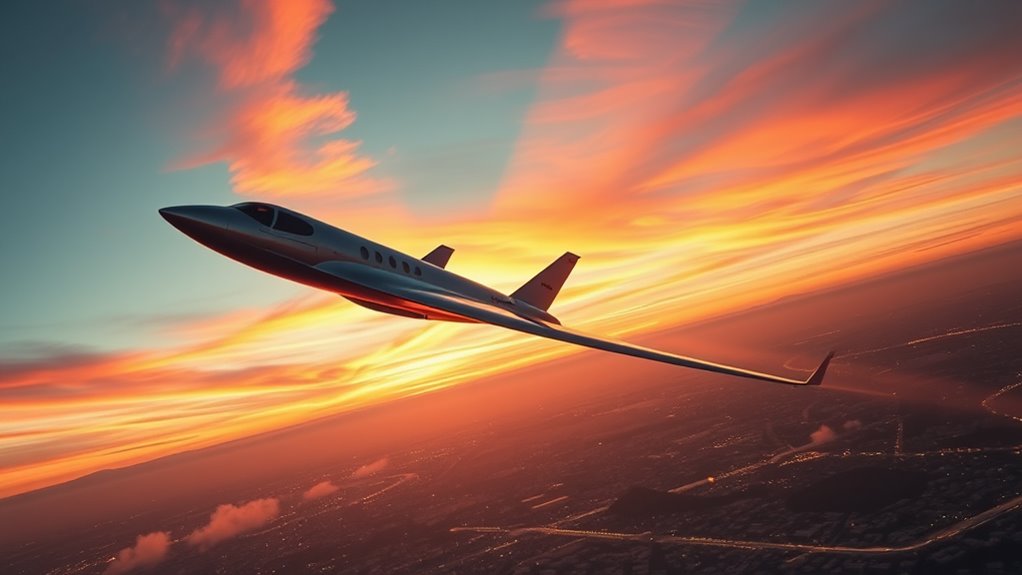
Hypersonic travel, characterized by speeds exceeding Mach 5, promises to transform the aviation environment. This innovative technology could reduce travel times greatly, enabling trips like New York to Tokyo in under two hours. Improved global connectivity would promote business expansion and economic growth. Nevertheless, it presents engineering challenges, such as developing materials resistant to extreme heat and managing safety protocols to guarantee passenger security. As advancements continue, including AI integration for navigation and sustainable fuel alternatives, hypersonic travel could reshape industries and redefine international relations. Exploring these state-of-the-art developments reveals a future filled with unprecedented possibilities.
Understanding Hypersonic Travel
Hypersonic travel, defined as flight at speeds exceeding Mach 5, represents a noteworthy leap in aviation technology. The quest for hypersonic flight necessitates a profound comprehension of various scientific principles, particularly those pertaining to thermal dynamics and propulsion systems. At these extreme velocities, the interaction between the aircraft and the atmosphere generates intense heat, imposing stringent thermal constraints on materials and structural design. As a result, engineers must prioritize advanced materials that can withstand extreme temperatures while maintaining structural integrity.
Moreover, propulsion systems for hypersonic vehicles diverge considerably from traditional jet engines. Scramjet technology, for instance, employs supersonic combustion to achieve the necessary thrust, compelling designers to innovate continuously within the parameters of velocity limits. These systems present unique challenges, necessitating a rigorous evaluation of design considerations that account for performance, efficiency, and reliability.
Safety protocols are paramount in the domain of hypersonic travel, where the stakes are exceedingly high. Engineers and designers must implement multifaceted safety measures to mitigate risks associated with mechanical failures and environmental hazards, especially during critical phases of flight.
Additionally, regulatory challenges loom large as existing frameworks struggle to accommodate the rapid advancements in hypersonic technology. National and international regulations must evolve to address the intricacies of airspace management, safety standards, and environmental impacts. As hypersonic travel advances, it will be crucial to navigate these challenges effectively to facilitate safe and sustainable implementation in the aviation environment.
Potential Benefits of Hypersonic Flights
There is great anticipation surrounding the potential benefits of hypersonic flights, which promise to transform global transportation. As these technologies mature, they offer a myriad of advantages that could reshape both commercial and military aviation environments. One of the most significant benefits lies in the drastic reduction of travel times. For instance, a flight from New York to Tokyo could be reduced from approximately 14 hours to under 2 hours, promoting unprecedented connectivity and enhancing global commerce.
In addition to speed, hypersonic travel could additionally contribute to environmental sustainability. Advanced propulsion systems being developed may facilitate more efficient fuel consumption and lower emissions per passenger mile. As the aviation industry grapples with its environmental footprint, the adoption of hypersonic technology could represent a substantial leap forward.
However, the integration of hypersonic travel into existing air traffic frameworks will necessitate stringent safety regulations. Ensuring passenger safety and operational reliability is paramount, requiring collaboration among regulatory bodies, manufacturers, and airlines to establish robust standards.
The economic implications of hypersonic flights are multifaceted. Although the initial investment in research and infrastructure may be significant, the long-term benefits, including reduced operational costs and increased market opportunities, could yield substantial returns. In addition, technological advancements stemming from hypersonic research could have spillover effects, driving innovation in other sectors.
Challenges Facing Hypersonic Technology
Maneuvering through the intricacies of hypersonic technology presents a formidable array of challenges that must be addressed before widespread implementation can occur. Among these, several critical factors necessitate immediate attention:
- Engineering Hurdles: Developing vehicles capable of withstanding extreme temperatures and pressures requires innovative materials and designs. Current material limitations hinder the creation of viable hypersonic crafts.
- Safety Concerns: The potential for catastrophic failures at hypersonic speeds raises significant safety issues. Addressing these concerns is crucial for gaining public confidence and regulatory approval.
- Cost Implications: The financial burden associated with research, development, and manufacturing of hypersonic technology can be prohibitive. Stakeholders must evaluate whether the return on investment justifies the costs involved.
Moreover, regulatory challenges pose a substantial barrier. Existing aviation regulations were not designed with hypersonic travel in mind, necessitating the establishment of new frameworks to manage airspace and operational protocols. Public perception likewise plays a critical role; concerns about noise pollution and environmental impact could hinder acceptance in communities near proposed flight paths.
Ultimately, overcoming these challenges is paramount to revealing the potential of hypersonic travel. A multifaceted approach that encompasses technological innovation, rigorous safety assessments, and proactive engagement with regulatory bodies and the public will be crucial to navigate this uncharted territory effectively. As the industry progresses, addressing these challenges will be integral to shaping the future of hypersonic flight.
Impact on Global Business and Tourism
Revolutionizing travel, hypersonic technology promises to reshape global business and tourism by drastically reducing flight times between major economic hubs. The potential of flying at speeds exceeding five times the speed of sound could transform the dynamics of international commerce, enabling executives to conduct face-to-face meetings in distant markets within hours rather than days. This immediacy not only improves operational efficiency but also nurtures stronger relationships and collaboration among global partners.
The economic implications of hypersonic travel are profound. By facilitating rapid business exchanges, companies may discover new markets and opportunities previously deemed impractical because of travel constraints. The reduced duration of trips could lead to increased productivity, as professionals allocate more time to strategic initiatives rather than time-consuming transit. Additionally, this advancement may stimulate investment in infrastructure and technology, further strengthening economic growth.
In the sector of tourism, hypersonic travel presents unprecedented travel accessibility. Destinations that were once remote or logistically challenging to reach could become prime targets for tourism, enriching local economies. The ability to traverse long distances in mere hours could encourage spontaneous travel decisions, greatly altering consumer behavior. As a result, hospitality and service sectors may need to adapt their offerings to cater to a more dynamic and diverse clientele.
Future Innovations in Aviation
As hypersonic travel reshapes global business and tourism, the aviation industry stands on the brink of transformative innovations that promise to improve efficiency and sustainability. The advent of hypersonic technology is not just about speed; it heralds a new era of aviation characterized by groundbreaking advancements that align with sustainable aviation goals.
Key innovations poised to redefine the environment include:
- Advanced Propulsion Systems: These systems will utilize alternative fuels and state-of-the-art aerodynamic designs to considerably reduce carbon emissions, improving the environmental performance of hypersonic aircraft.
- Autonomous Flight Technologies: Leveraging artificial intelligence and machine learning, these technologies aim to boost safety and operational efficiency, allowing for more flexible flight paths and reduced air traffic congestion.
- Enhanced Regulatory Frameworks: As the industry progresses, robust regulatory frameworks will be necessary to guarantee safety and compliance, cultivating an environment that encourages innovation as it maintains public trust.
The convergence of these innovations not just paves the way for faster travel but also guarantees that the aviation sector contributes positively to global sustainability efforts. Stakeholders, from manufacturers to regulators, must collaborate to create policies that facilitate these advancements as they address environmental concerns. In the end, the future of aviation lies in a balanced approach that embraces innovation and sustainability, setting the stage for a new chapter in air travel that is both efficient and responsible.
Frequently Asked Questions
What Are the Current Hypersonic Vehicles in Development?
Envision soaring through the skies at speeds that render the speed of sound a mere whisper. Currently, several hypersonic vehicles are in development, including the U.S. Air Force's X-51A Waverider and the DARPA HTV-2, designed for military applications. Concurrently, commercial prospects are taking shape with companies like Hermeus, aiming to transform air travel. These advancements promise to redefine our comprehension of speed, efficiency, and global connectivity in both defense and civilian sectors.
How Does Hypersonic Travel Affect the Environment?
Hypersonic travel presents significant concerns regarding its environmental impact. The high speeds involved could lead to increased fuel consumption and resultant greenhouse gas emissions, exacerbating climate change. Furthermore, the sonic booms generated during hypersonic flight contribute to noise pollution, adversely affecting communities beneath flight paths. As the industry advances, it is crucial to address these environmental challenges to guarantee sustainable development of hypersonic technologies, balancing innovation with ecological responsibility.
What Speeds Define Hypersonic Travel?
Hypersonic travel is defined by speed thresholds exceeding Mach 5, or approximately 3,836 miles per hour (6,174 kilometers per hour) at sea level. This classification signifies a significant leap in aerodynamic performance and thermal dynamics compared to subsonic and supersonic flight. Achieving such speeds poses unique engineering challenges, including heat management and propulsion efficiency, which are critical for the advancement of future aerospace technologies and applications in both military and civilian domains.
Will Hypersonic Flights Be Affordable for Average Consumers?
The affordability of hypersonic flights for the average consumer hinges on several cost factors, including technological development, operational efficiency, and infrastructure investment. Currently, the high expenses associated with research, manufacturing, and maintenance pose significant barriers to market accessibility. Nevertheless, as advancements in technology reduce these costs over time, the potential for hypersonic travel to become a viable option for the broader public may emerge, transforming the terrain of commercial aviation.
How Does Hypersonic Travel Compare to Supersonic Travel?
How do speed advancements in hypersonic travel truly differentiate it from supersonic travel? Although both modes exceed the speed of sound, hypersonic travel surpasses Mach 5, enabling unprecedented global reach. Nevertheless, the technological challenges of achieving and sustaining such speeds, along with efficient propulsion systems, remain significant hurdles. On the other hand, supersonic travel, operating between Mach 1 and Mach 2, has established commercial viability but lacks the transformative potential of its hypersonic counterpart.
